Compare · Digital business card with a scanner
Krane vs Blinq
Blinq is a digital business card you share by QR code or NFC, with a contact scanner on its free plan. Krane is a card and badge scanner for iPhone, iPhone Duo and iPad that sends what it reads to HubSpot, Salesforce or Pipedrive.
Facts about Blinq checked on its own pages, November 8, 2026
Drawing: a Blinq-style digital business card as a Wallet pass with a QR code, and a list of three scans waiting in an offline queue until the phone is back online.
Drawing: a paper business card for Jane Cooper, Head of Sales at Northwind Labs, read by Krane into a contact with the name, title, company, mobile number, email and website each in its own field.
- Free plan
- BlinqScanner on the free plan, no limit stated; no CSV export
- Krane10 scans a week, no account
- Paid plan (US)
- BlinqPremium $9.99 a month or $87.99 a year; Pro $22.49 or $199; Business $6.99 per card a month (5 minimum)
- Krane$11.99 a month or $95.99 a year
- Native CRM sync
- BlinqSalesforce, HubSpot, Dynamics 365, Pipedrive, Zoho and more, on Business
- KraneHubSpot, Salesforce, Pipedrive (Pro)
The short answer
Pick Blinq if you want a digital card of your own and a scanner on a free plan with no stated scan limit. Pick Krane if you want the cards you collect in HubSpot, Salesforce or Pipedrive, or in a CSV, without a team plan.
On Blinq, CSV export is on Pro ($22.49 a month or $199 a year) and native CRM sync is on Business, priced per card with a five-card minimum, as listed on November 8, 2026. Krane Pro covers both for one person and reads each card on the iPhone with no signal. Blinq runs on Android, Mac and the web; Krane runs only on iPhone, iPhone Duo and iPad. Using both works: Blinq for your own card, Krane for the cards you’re handed.
When Blinq is the better pick
- You want a digital card of your own. Blinq gives you two free, shared by QR code, NFC, Wallet pass or email signature.
- You’re on Android, or want a Mac app or a web dashboard. Krane runs only on iPhone, iPhone Duo and iPad.
- You run a team. Blinq Business has an admin platform, user provisioning and single sign-on through Okta, Entra ID or Google Workspace.
- Your CRM is Dynamics 365, Zoho or GoHighLevel. Blinq lists native integrations for them; Krane reaches them only through a webhook or a CSV.
Blinq’s scanner is also on its free plan with no stated scan limit, and it sells contact enrichment that fills in missing emails and phones per lead.
Blinq's siteWhen Krane is the better pick
- You want scans in HubSpot, Salesforce or Pipedrive as one person. Krane Pro sends them; Blinq puts native CRM sync on Business, five cards minimum.
- You want a CSV. Krane Pro exports one event or all cards; on Blinq, CSV export starts at Pro.
- You scan with no signal. Krane reads the card on the iPhone right away; Blinq queues the scan until you’re online.
- You don’t want an account. Krane has no sign-up; cards and CRM tokens stay on the iPhone.
- You collect cards in Japanese, Chinese or Korean. Krane reads almost any script; Blinq’s pages don’t say which languages its scanner reads.
Krane is a scanner only, with no digital card to share.
Side by side
Blinq and Krane, feature by feature
| Feature | Blinq | Krane |
|---|---|---|
| What it is | Digital business card platform with a contact scannersource | A business card and badge scanner |
| Platforms | ✓ iPhone, Android, Mac, Apple Watch, web (no iPad listed)source | ◐ iPhone, iPhone Duo and iPad |
| Works without an account | ✕ No, contacts live in your Blinq accountsource | ✓ Yes, there is no account at all |
| Free plan | ✓ Scanner on the free plan, no limit stated; no CSV exportsource | ✓ 10 scans a week, no account |
| Paid plan (US) | Premium $9.99 a month or $87.99 a year; Pro $22.49 or $199; Business $6.99 per card a month (5 minimum)source | $11.99 a month or $95.99 a year |
| How paper cards are read | ? Not documented; enrichment runs onlinesource | ✓ Read on the iPhone at once, checked again online; every field filled |
| Several cards at once | ? Unknown | ✓ Card after card; a group of cards from one photo (Pro) |
| Reads cards with no signal | ◐ Scans queue on the phone; contacts are made when back onlinesource | ✓ Yes, read on the iPhone, checked again when back online |
| Event badges | ✓ Reads badges, QR codes and name tagssource | ✓ QR, PDF417, Aztec and other codes, merged with the printed name |
| Cards filed by event | ◐ Event campaigns on Businesssource | ✓ Yes: every scan during an event is filed under it |
| Native CRM sync | ◐ Salesforce, HubSpot, Dynamics 365, Pipedrive, Zoho and more, on Businesssource | ✓ HubSpot, Salesforce, Pipedrive (Pro) |
| Zapier or webhook | ✓ Zapier (plan unclear)source | ✓ Signed webhook for Zapier, Make, n8n (Pro) |
| Export to Excel / CSV | ◐ CSV on Pro and upsource | ✓ CSV of one event or all cards (Pro) |
| Where your contacts live | Blinq's cloud (SOC 2 Type II)source | On your iPhone; backup to one file |
| Team admin | ✓ Admin platform, SSO on Business; SCIM on Enterprisesource | ✕ No: each person on their own Apple Account |
| Digital business card | ✓ Yes: QR, NFC, Wallet, email signaturesource | ✕ No; shares any card as a vCard |
Blinq: read on Blinq's own website, help pages and App Store listing on November 8, 2026; "Unknown" means we couldn't confirm it there. Prices are US list prices; plans change, so check Blinq before you buy. Krane Pro's price is the US price; the App Store shows the price for your account and country. Something wrong or out of date? Write to [email protected].
What Blinq is, and what Krane is
Blinq is a digital business card platform. The card is the product: two cards free, five on Premium or Pro, shared by QR code, NFC, Wallet pass or email signature. Around the card sit a “Universal contact scanner” for business cards, badges and QR codes, an AI notetaker for meetings, and, for Business teams, lead enrichment and CRM sync. It runs on iPhone, Mac, Apple Watch, Apple Vision and Android, with a web dashboard. Your contacts live in your Blinq account.
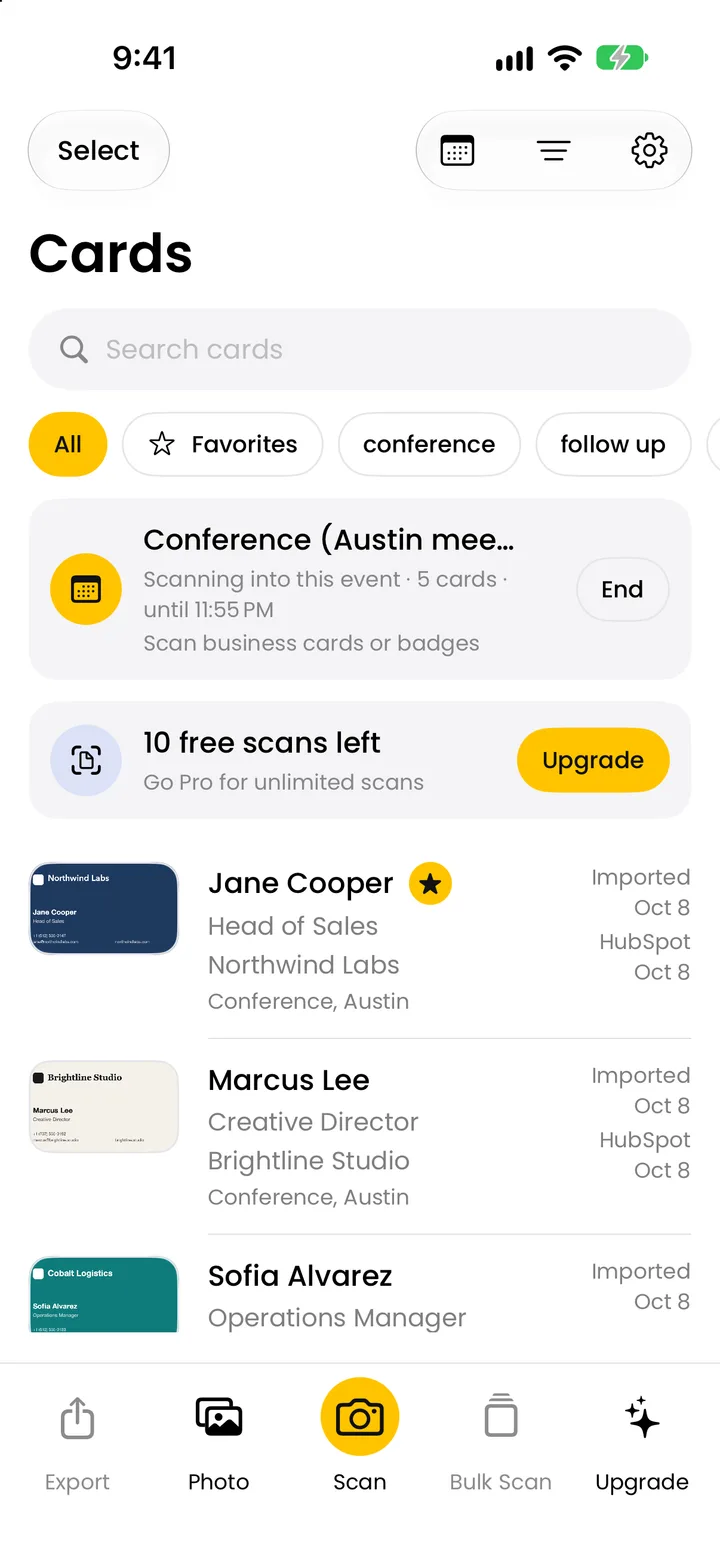
Krane is a scanner for the cards and badges other people hand you. It runs on iPhone, iPhone Duo and iPad. It reads the card, files it under the event you’re at, and sends it to Apple Contacts, a CSV, or HubSpot, Salesforce or Pipedrive. There is no account; everything is stored on the device and backs up to one file. It does not make a digital card for you.
The difference is one of kind: Blinq is a card you share that also scans; Krane is a scanner.
Scanning paper cards
Blinq’s scanner is on the free plan, and neither its pricing page nor its plan articles state a scan limit. Its documentation says Blinq reads the contact details and starts enrichment. It doesn’t say whether the reading happens on the phone or on a server, which languages it reads, or whether it reads several cards in one shot. The App Store lists the app in English only.
Krane reads a card into named fields: person name, job title, company, phone numbers labeled mobile, work, fax or other, email addresses, websites, social profiles, street address, and anything else printed. It reads almost any language and script, including Japanese, Chinese and Korean, and adds a Latin spelling to a name written in another script. Add the back of a card and both sides are read into one contact.
For a stack, hold the iPhone over the table and lay cards down one at a time. The business card scanner shoots each card once it is still and reads it while you set down the next. Free users scan three in a row per session and 10 cards per rolling seven-day week. With Krane Pro there is no cap, and a Group of cards mode reads a whole spread from one photo. You can also add card photos from the library, several at once.
At trade shows and events
Both apps read event badges. Blinq’s universal scanner reads event badges, QR codes, LinkedIn QR codes and name tags. Its Business plan adds a Lead Capture Mode and event campaigns: set a date range, location and team, and contacts captured in that window are tagged to the event, with event cost and deal size recorded for attribution. Blinq’s pages don’t list which barcode formats it decodes.
Krane’s badge scanner reads the printed name, title, company, event name, badge role and badge number, plus QR, PDF417 and Aztec codes and other common barcodes. Contact data in the code is merged with the print into one contact. Encrypted badge codes can’t be decoded; Krane still saves the printed name, title, company and event. Krane files trade show lead capture by event, on the free plan: start one when you reach the venue and every card and badge you scan lands under it, with “Met at” and the event’s tags filled in.
With no signal, Blinq queues each scan and creates, enriches and syncs the contacts once you’re back online; its support article says availability depends on your plan. Krane reads the card on your iPhone right away and checks it again when you’re back online.
Getting contacts into your CRM
Blinq lists native integrations with Salesforce, HubSpot, Microsoft Dynamics 365 Sales, Pipedrive, Zoho CRM, GoHighLevel and Outlook Contacts, on its Business and Enterprise plans. Integrations export from the company’s contacts, so a personal contact has to be shared to the company first. Zapier is on its integrations page; the plan it needs isn’t stated clearly. CSV export of contacts and notes is on Pro and above. Blinq’s pages don’t mention a webhook.
Krane Pro connects to HubSpot, Salesforce and Pipedrive from the app, and the tokens stay on the iPhone. HubSpot gets a contact, updated if one with the same email exists; the event, tags and notes stay in Krane. Salesforce gets a Lead or a Contact, your choice, with LeadSource set to “Krane” and the event, where you met, tags and notes in the Description field. Pipedrive gets a person, linked to an organization with the card’s company name, and a note carrying the event, tags and notes. A webhook posts each card as JSON to Zapier, Make, n8n or your own server, signed with a shared secret.
Send one card, a selection, a whole event, or every new scan automatically. The CSV covers one event or all cards and opens in Excel, Numbers and Google Sheets.
Price
| Plan | Blinq | Krane |
|---|---|---|
| Free plan | $0: two digital cards, unlimited sharing and contacts, the contact scanner | $0: 10 scans a week, events, badges, offline reading, Apple Contacts |
| Paid plan | Premium $9.99 a month or $87.99 a year; Pro $22.49 a month or $199 a year; Business $6.99 per card a month, or $4.99 per card a month yearly, five cards minimum | Krane Pro $11.99 a month or $95.99 a year |
| What the paid plan adds | Premium: five cards. Pro: CSV export. Business: native CRM sync, lead capture, team admin, single sign-on, per-lead enrichment | Unlimited scans, group scan, CSV export, CRM sync (HubSpot, Salesforce, Pipedrive, webhook), auto-send of new scans |
Blinq’s prices are as listed on November 8, 2026. Premium and Pro have a 7-day trial, Business a 30-day one. Krane Pro has no trial; the free plan is how you try it. Krane has no team plan, so each person subscribes on their own Apple Account (see pricing). The App Store shows the price for your account and country.
Where your contacts live
Blinq contacts live in your Blinq account, on Blinq’s servers, and team and company contacts are shared across the company. Blinq states SOC 2 Type II and GDPR compliance. Its pages don’t say where the servers are. A web dashboard shows the same contacts on a computer.
Krane has no account. Cards and CRM tokens are stored on the iPhone, iPhone Duo or iPad you scan with. Each card is read on your iPhone first, right away, and checked again when you’re back online. The whole library backs up to one file, which you restore on a new device. A card you add to Apple Contacts goes wherever your Apple Contacts already sync.
Switching
Switching from Blinq to Krane
Krane can’t import a CSV, vCard or another app’s export, so there is no transfer step.
- Keep what’s in Blinq. On Blinq Pro, export your contacts and notes as a CSV for your records; on Free or Premium, they stay in your Blinq account.
- Install Krane on your iPhone, iPhone Duo or iPad. There is no sign-up.
- Scan new cards with Krane from now on. At a show, start the event first so each card is filed under it.
- If you kept photos of old cards, add them from the photo library, several at once. Each one becomes a contact.
- With Krane Pro, connect HubSpot, Salesforce or Pipedrive, or export a CSV.
If Blinq is your own card, keep it: Blinq for the card you hand out, Krane for the cards you collect. Other scanners are on the all comparisons page.
FAQ
Questions about Krane and Blinq
Is Krane a good Blinq alternative?
For the scanner, yes: Krane reads cards and badges on the iPhone with no signal and, with Krane Pro, sends them to HubSpot, Salesforce or Pipedrive or exports a CSV, with no team plan needed. For the digital card, no. Krane does not make a card for you to share, and it runs only on iPhone, iPhone Duo and iPad.
Is Blinq free?
Blinq has a free plan, as listed on November 8, 2026: up to two digital cards, unlimited sharing and contact creation, the contact scanner, Wallet passes and an email signature. CSV export needs Pro, and native CRM sync needs Business. Krane’s free plan is 10 scans a week, with events, badge scanning and Apple Contacts included.
Which is cheaper, Blinq or Krane?
It depends on what you need. Blinq’s scanner is on its free plan. If you want a CSV, Blinq Pro is $22.49 a month or $199 a year; for CRM sync, Business is $6.99 per card a month with a five-card minimum, as listed on November 8, 2026. Krane Pro, which includes CSV export and CRM sync, is $11.99 a month or $95.99 a year. The App Store shows the price for your account and country.
Does Blinq scan business cards?
Yes. Blinq’s “Universal contact scanner” reads business cards, event badges and QR codes, and its pricing page and plan articles include it in the free plan. Blinq’s pages don’t say how it reads a card, which languages it handles, or whether it can read several cards in one photo.
Which one works without internet?
Krane reads the card on your iPhone right away, with no signal, and checks it again when you’re back online. Blinq’s support article says offline scans are queued on the device, and the contacts are created, enriched and synced once you’re back online; it adds that availability depends on your plan.
Can Blinq and Krane scan trade show badges?
Both do. Blinq’s scanner reads event badges, QR codes and name tags, and its Business plan adds a Lead Capture Mode and event campaigns. Krane reads the printed name, title, company, event, role and badge number plus QR, PDF417 and Aztec codes, on the free plan. Krane can’t decode a badge code the show has encrypted; it keeps the printed details in that case.
Which CRMs do Blinq and Krane connect to?
Blinq lists Salesforce, HubSpot, Microsoft Dynamics 365 Sales, Pipedrive, Zoho CRM, GoHighLevel and Outlook Contacts, on its Business and Enterprise plans, plus Zapier. Krane Pro connects to HubSpot, Salesforce and Pipedrive from the app and posts to a webhook for Zapier, Make, n8n or your own server. Other CRMs reach Krane’s data through the webhook or a CSV.
Do I need an account to use Krane?
No. There is no sign-up. Your cards, events and CRM tokens are stored on your iPhone, iPhone Duo or iPad, and the whole library backs up to one file you can restore any time. Krane Pro is a subscription billed through the App Store on your Apple Account.
Does Krane work on Android?
No. Krane runs on iPhone, iPhone Duo and iPad only, and requires iOS 17.6 or later. There is no Android, Mac, Windows or web version. Blinq lists apps for iPhone, Mac, Apple Watch, Apple Vision and Android, with a web dashboard, so if you need Android or a browser, Blinq is the one of the two that covers it.
Can I move my contacts from Blinq to Krane?
Not directly. Krane has no importer, so it can’t read a CSV, vCard or Blinq export. Keep your Blinq contacts where they are, or export them as a CSV on Blinq Pro for your own records. From then on, scan new cards with Krane, and add photos of old cards from your photo library if you still have them.
Can I use Blinq and Krane together?
Yes, and they don’t overlap much. Blinq carries your own digital card, shared by QR code, NFC or Wallet pass. Krane scans the cards and badges you’re handed, files them under the event, and sends them to your CRM or a CSV. Keep your card in Blinq and your collected contacts in Krane.
Does Blinq run on iPad?
Blinq’s App Store listing, checked November 8, 2026, names iPhone, Mac, Apple Watch and Apple Vision and does not list iPad. Krane is a universal app and runs on iPhone, iPhone Duo and iPad with the same subscription on one Apple Account.
Read the cards you're handed, straight into a contact.
Free for 10 scans a week. Krane Pro adds unlimited scans, export and CRM sync.
On a computer? Point your iPhone camera at the code, or text me the link.